Sep 28, 2026
Why Does Handheld Laser Welding Produce Cracks?
Cracks can weaken a weld and affect long-term durability. This guide covers the main causes and practical ways to reduce cracking during handheld laser welding.
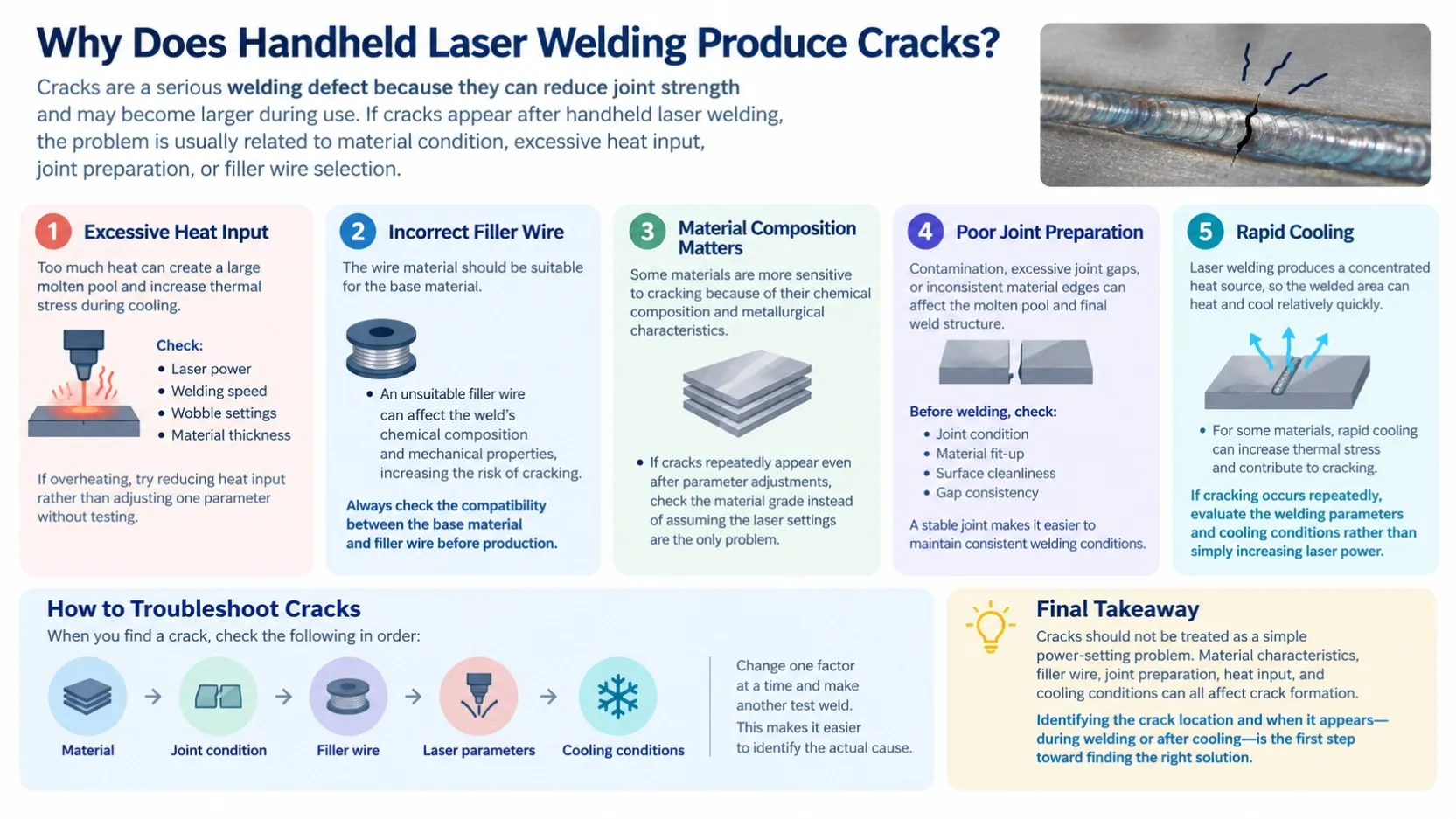
Cracks are a serious welding defect because they can reduce joint strength and may become larger during use. If cracks appear after handheld laser welding, the problem is usually related to material condition, excessive heat input, joint preparation, or filler wire selection.
1. Excessive Heat Input
Too much heat can create a large molten pool and increase thermal stress during cooling.
Check:
- Laser power
- Welding speed
- Wobble settings
- Material thickness
If the weld is overheating, try reducing heat input rather than simply increasing or decreasing one parameter without testing.
2. Incorrect Filler Wire
For applications using filler wire, the wire material should be suitable for the base material.
An unsuitable filler wire can affect the weld's chemical composition and mechanical properties, increasing the risk of cracking.
Always check the compatibility between the base material and filler wire before production.
3. Material Composition Matters
Some materials are more sensitive to cracking because of their chemical composition and metallurgical characteristics.
If cracks repeatedly appear even after parameter adjustments, check the material grade instead of assuming the laser settings are the only problem.
4. Poor Joint Preparation
Contamination, excessive joint gaps, or inconsistent material edges can affect the molten pool and final weld structure.
Before welding, check:
- Joint condition
- Material fit-up
- Surface cleanliness
- Gap consistency
A stable joint makes it easier to maintain consistent welding conditions.
5. Rapid Cooling
Laser welding produces a concentrated heat source, so the welded area can heat and cool relatively quickly.
For some materials, rapid cooling can increase thermal stress and contribute to cracking.
If cracking occurs repeatedly, evaluate the welding parameters and cooling conditions rather than simply increasing laser power.
How to Troubleshoot Cracks
When you find a crack, check the following in order:
Material → Joint condition → Filler wire → Laser parameters → Cooling conditions
Change one factor at a time and make another test weld. This makes it easier to identify the actual cause.
Cracks should not be treated as a simple power-setting problem. Material characteristics, filler wire, joint preparation, heat input, and cooling conditions can all affect crack formation.
Identifying the crack location and when it appears—during welding or after cooling—is the first step toward finding the right solution.