Sep 24, 2026
How Does Material Reflectivity Affect Handheld Laser Welding?
Learn how material reflectivity affects laser energy absorption, penetration, and weld quality, especially when welding reflective metals such as aluminum and copper.
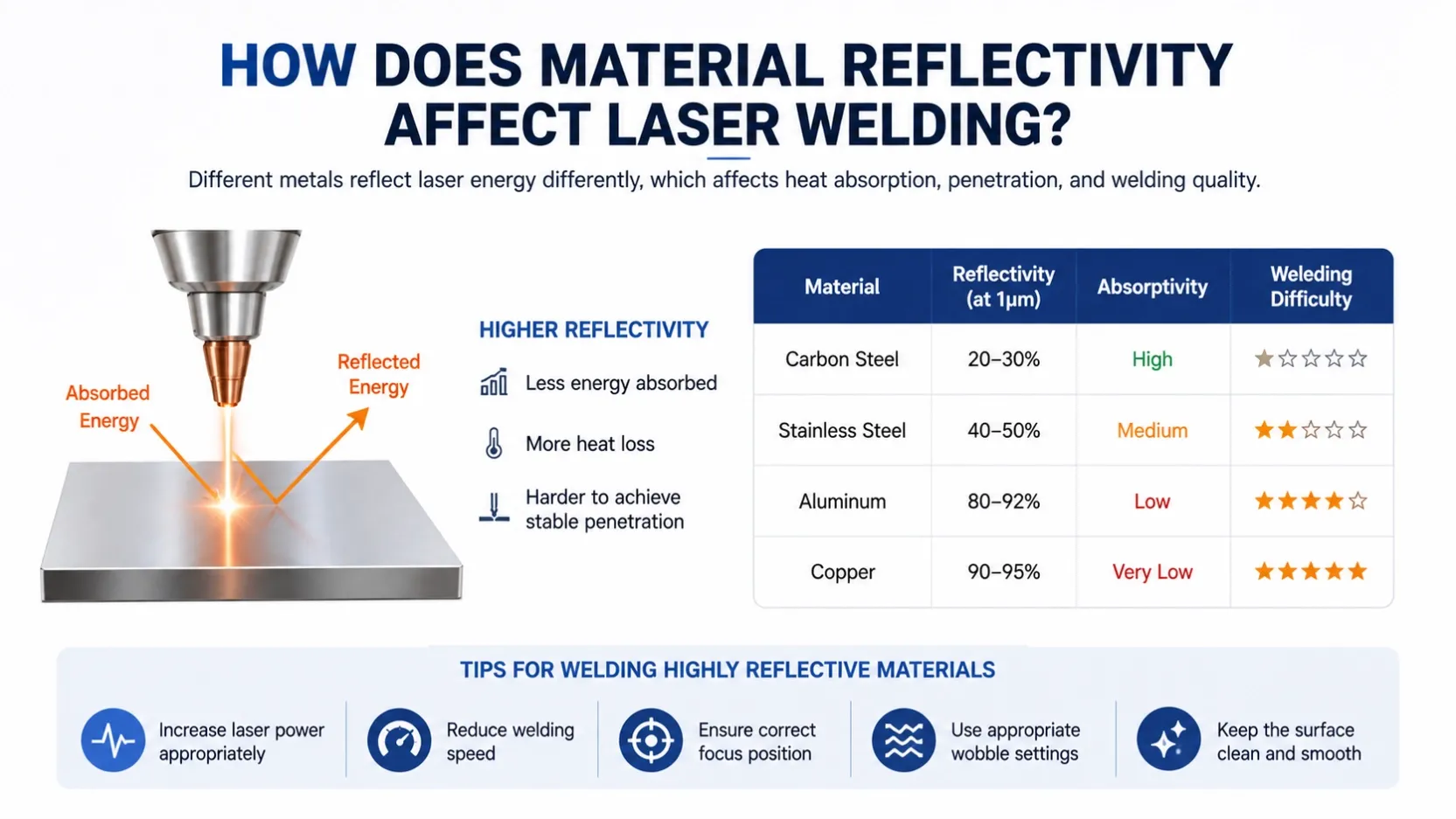
Different metals absorb laser energy differently. This is especially important when welding highly reflective materials such as aluminum and copper. A parameter that works well on stainless steel may not produce the same result on a reflective metal.
Understanding material reflectivity can help you choose more suitable welding parameters and avoid unstable results.
1. Why Does Reflectivity Matter?
When the laser beam reaches the workpiece, part of the energy is absorbed and converted into heat, while some energy can be reflected.
Materials such as stainless steel and carbon steel generally absorb laser energy more easily than highly reflective metals such as aluminum and copper.
This means reflective materials may require different welding conditions to achieve stable melting and penetration.
2. Aluminum Can Behave Differently
Aluminum has high reflectivity and high thermal conductivity.
During handheld laser welding, heat can spread quickly away from the welding area. As a result, you may notice:
- Difficulty achieving sufficient penetration
- A wider difference between surface appearance and actual penetration
- Greater sensitivity to laser power and welding speed
- Different results compared with stainless steel at the same settings
Do not simply copy parameters from another material.
3. Copper Requires Extra Attention
Copper is even more challenging because of its high reflectivity and thermal conductivity.
If the laser energy is not effectively coupled into the material, the molten pool may be difficult to establish or maintain.
When welding copper, pay particular attention to:
- Laser power
- Welding speed
- Focus position
- Material thickness
- Surface condition
Small parameter changes can have a noticeable effect on the welding result.
4. Don't Compensate With Power Alone
When penetration is insufficient, increasing laser power may seem like the easiest solution.
However, power should not be the only parameter you change.
A better approach is to evaluate power, welding speed, focus position, and wobble settings together. Excessive power can also increase heat input and create unnecessary deformation or surface defects.
5. Test the Actual Material
Different grades, thicknesses, and surface conditions can change the welding result.
Before production:
- Clean the material surface.
- Start with conservative parameters.
- Make a test weld.
- Check penetration and weld appearance.
- Adjust one parameter at a time.
- Record the final settings for repeat production.
Material reflectivity is an important factor when welding aluminum, copper, and other reflective metals. The same laser settings cannot always be transferred directly between different materials.
For more stable results, match the laser power, welding speed, focus, and wobble settings to the actual material and thickness instead of relying on power alone.