Aug 5, 2026
Why Does the Protective Lens Burn Frequently During Laser Welding?
Learn why Protective Lens burns frequently during laser welding and how spatter, gas settings, focus, parameters, and operation affect lens lifetime. Improve welding stability with proper maintenance.
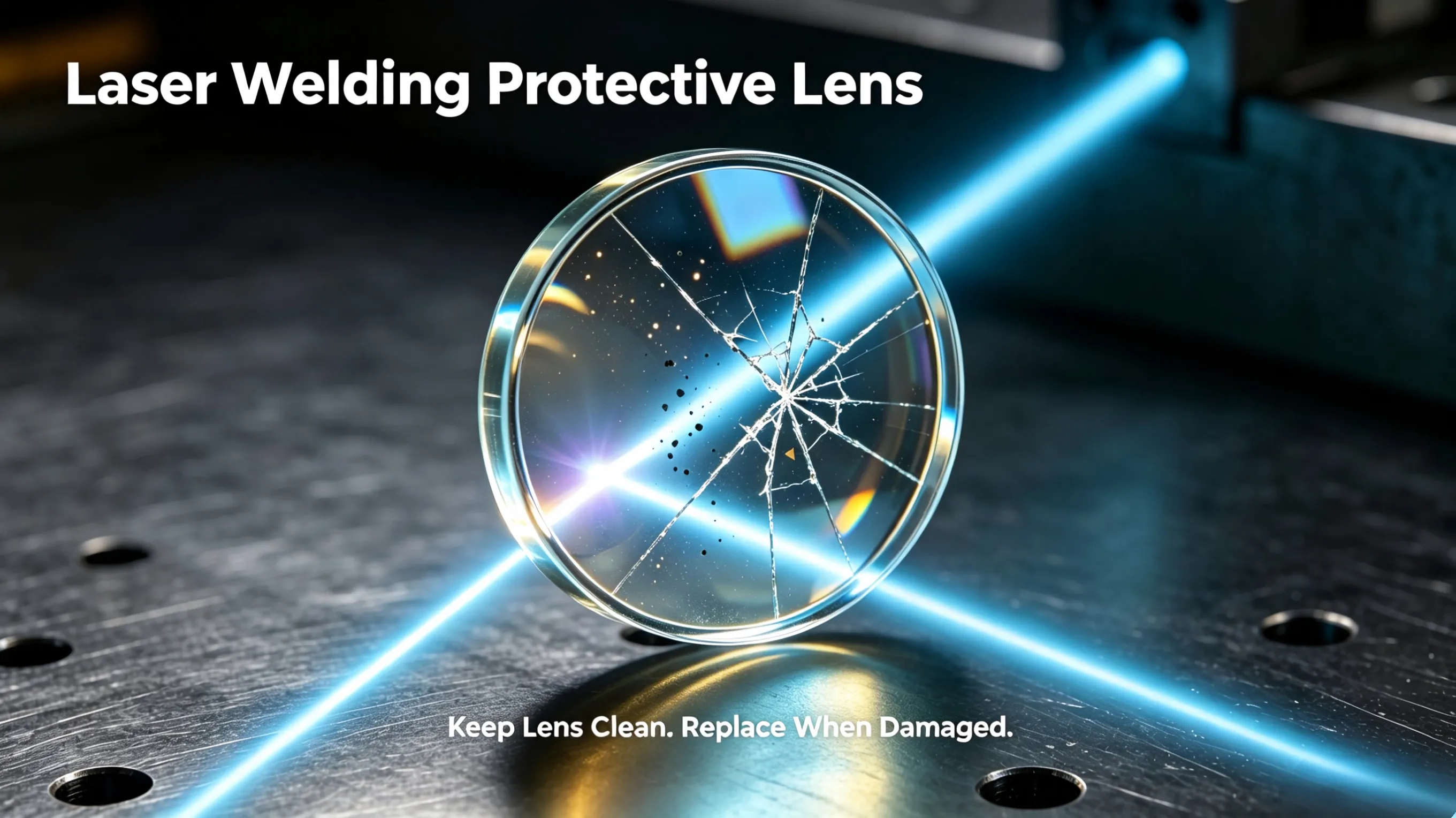
The Protective Lens is one of the most important consumable parts in a Handheld Welding Machine. It protects the internal optical components from welding spatter, smoke, dust, and other contaminants during the welding process.
However, many users experience a common problem:
Why does the Protective Lens burn frequently during laser welding?
Unlike laser cutting, laser welding produces more metal spatter and heat reflection. If the welding process is not properly adjusted, the Protective Lens may become contaminated, overheated, or damaged within a short time.
Understanding the main causes of Protective Lens damage can help users reduce maintenance costs, improve welding stability, and extend the service life of consumables.
1. Excessive Welding Spatter
Welding spatter is one of the most common reasons for Protective Lens damage.
During laser welding, molten metal particles may splash back toward the welding nozzle and enter the optical path. Continuous spatter accumulation can cause:
- Burn marks on the Protective Lens
- Reduced laser transmission
- Lens cracking
- Unstable welding performance
Solution:
To reduce welding spatter:
- Optimize welding parameters
- Maintain proper welding distance
- Select suitable laser power
- Keep the welding nozzle clean
A stable welding process can significantly extend the lifetime of the Protective Lens.
2. Incorrect Welding Parameters
Welding parameters directly affect heat input and spatter generation.
Common parameter problems include:
- Laser power too high
- Welding speed too slow
- Incorrect wobble width
- Improper frequency settings
Excessive energy concentration may increase heat reflection and molten metal splash, causing the Protective Lens to burn faster.
Solution:
Adjust welding parameters according to:
- Material type
- Material thickness
- Welding position
- Required weld quality
Different materials require different parameter settings to achieve stable results.
3. Improper Shielding Gas Settings
Shielding gas plays an important role in protecting the welding area and maintaining weld quality.
Incorrect gas settings may increase contamination inside the welding head.
Common problems include:
- Insufficient gas flow
- Unstable gas pressure
- Incorrect gas direction
Poor gas protection allows more smoke and metal particles to reach the Protective Lens.
Solution:
Check:
- Gas purity
- Gas pressure
- Gas flow stability
Proper shielding gas settings help protect both the weld area and the Protective Lens.
4. Incorrect Focus Position
The focus position affects how laser energy is distributed during welding.
An incorrect focus position may lead to:
- Unstable welding
- Excessive spatter
- Uneven weld appearance
- Increased heat reflection
The additional heat generated during the process can accelerate Protective Lens damage.
Solution:
Check the distance between the welding nozzle and the workpiece, and adjust the focus position according to the recommended welding parameters.
5. Incorrect Welding Gun Angle
The operating angle of the handheld welding gun directly affects the direction of molten metal and spatter.
An incorrect welding angle may cause more particles to reflect back toward the nozzle and Protective Lens.
Common mistakes include:
- Holding the welding gun at an incorrect angle
- Unstable hand movement
- Incorrect welding direction
Solution:
Maintain a consistent welding angle and stable movement speed.
Proper operator training can reduce unnecessary lens contamination and improve welding consistency.
6. Using Low-Quality Protective Lens
The quality of the Protective Lens directly affects its service life and welding stability.
Low-quality lenses may have:
- Poor coating performance
- Lower heat resistance
- Unstable optical transmission
Under high-temperature welding conditions, low-quality lenses are more likely to burn, crack, or lose transmission efficiency.
Solution:
Choose high-quality Protective Lens products with:
- Stable coating technology
- High laser transmission efficiency
- Excellent thermal resistance
Reliable Protective Lens products help maintain stable welding performance and reduce replacement frequency.
How to Extend Protective Lens Lifetime?
Regular maintenance is essential for reducing Protective Lens replacement frequency.
Recommended practices:
- Inspect the Protective Lens regularly
- Clean the welding nozzle frequently
- Keep the welding area clean
- Replace damaged lenses immediately
- Avoid operating with a contaminated lens
Preventive maintenance helps reduce unexpected downtime and improve production efficiency.
Professional Protective Lens Solution for Laser Welding
As a professional supplier of fiber laser accessories, we provide high-quality Protective Lens solutions for laser welding and cutting applications.
Our product range includes:
- Protective Lens
- Laser Nozzles
- Ceramic Components
- Laser Head Accessories
Compatible with major laser systems, our products help customers maintain stable laser performance and reduce maintenance costs.
Frequent Protective Lens burning during laser welding is usually caused by excessive spatter, incorrect welding parameters, poor shielding gas settings, improper focus position, incorrect welding angles, or low-quality consumables.
By identifying the real cause and following proper maintenance procedures, users can extend Protective Lens lifetime and improve the performance of their Handheld Welding Machine.
Choosing the right Protective Lens and maintaining the welding system correctly are essential for achieving stable, efficient, and high-quality laser welding results.