Sep 18, 2026
How Does Workpiece Clamping Affect Handheld Laser Welding?
Proper workpiece clamping helps prevent movement and deformation, ensuring more stable and consistent laser welding results.
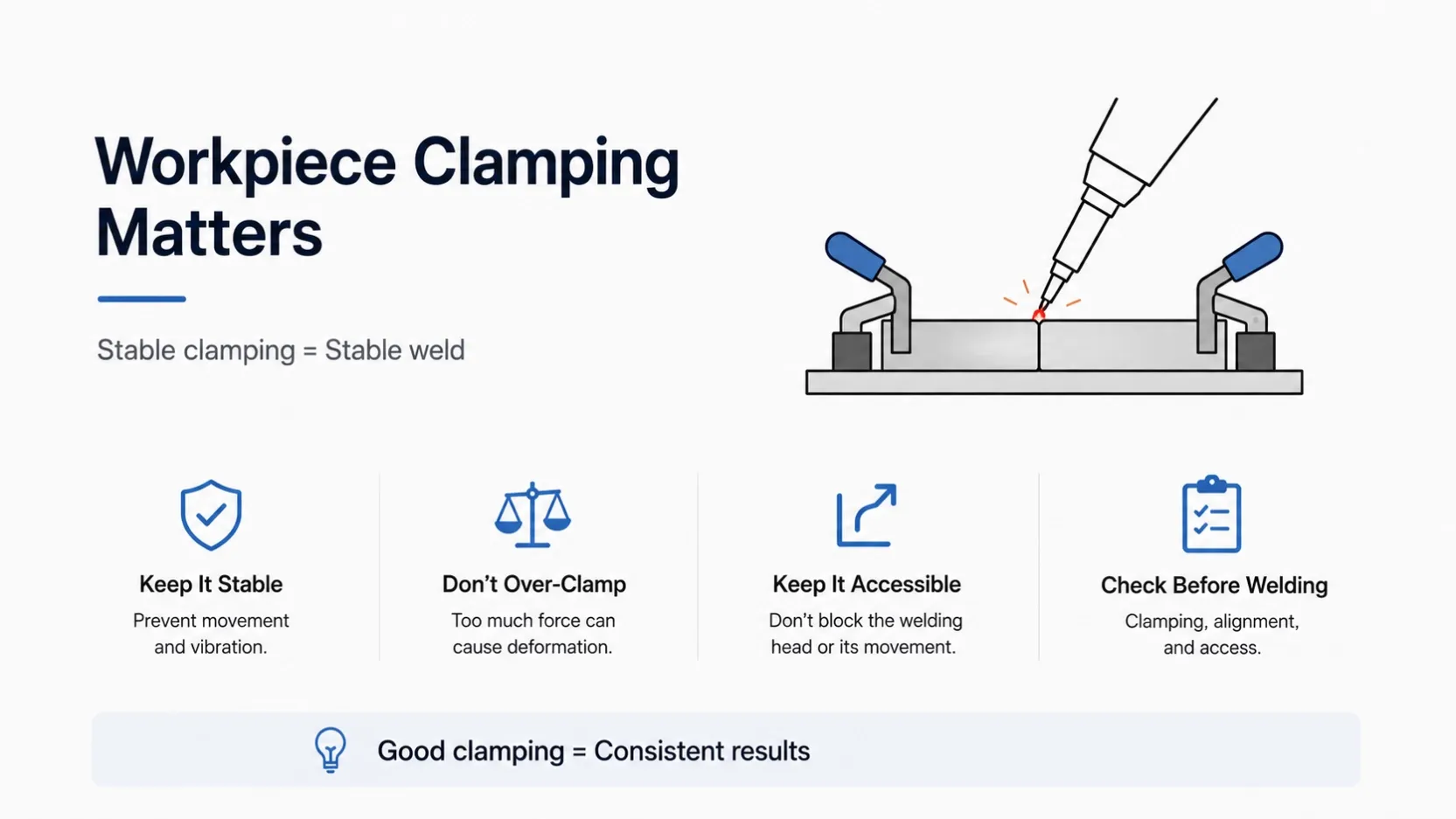
The way a workpiece is fixed can directly affect welding stability. Even with the same laser settings, a poorly secured workpiece may move, vibrate, or deform during welding.
1. Keep the Workpiece Stable
If the metal moves slightly during welding, the laser may no longer stay accurately on the joint.
This can cause an inconsistent weld bead or local lack of fusion.
Check:
Make sure the workpiece is firmly fixed before welding.
2. Avoid Excessive Clamping Force
Clamping too tightly can also cause problems, especially with thin sheet metal.
Excessive force may deform the parts before welding. When the clamps are removed, the workpiece can spring back and change its shape.
Try:
Use enough force to hold the parts securely without unnecessarily deforming them.
3. Keep the Joint Accessible
Clamps should hold the workpiece without blocking the movement of the Handheld Welding Head.
If the operator has to change the welding angle or move around the fixture, welding consistency can become difficult to maintain.
4. Check After Fixing
Before starting the weld, quickly check:
- Are the parts firmly fixed?
- Is the joint still correctly aligned?
- Is the workpiece deformed by the clamps?
- Can the Handheld Welding Head move smoothly?
Quick Tip
Fix the workpiece → Check alignment → Check access → Start welding
A stable workpiece gives the laser a stable welding path.
Good clamping creates a stable foundation for laser welding.
Use suitable fixtures and clamping force to keep the workpiece stable without restricting the welding movement.