Sep 20, 2026
How Does Duty Cycle Affect Handheld Laser Welding?
Duty cycle is key to stable long-term welding. Learn what to consider when choosing a laser welding machine for continuous production.
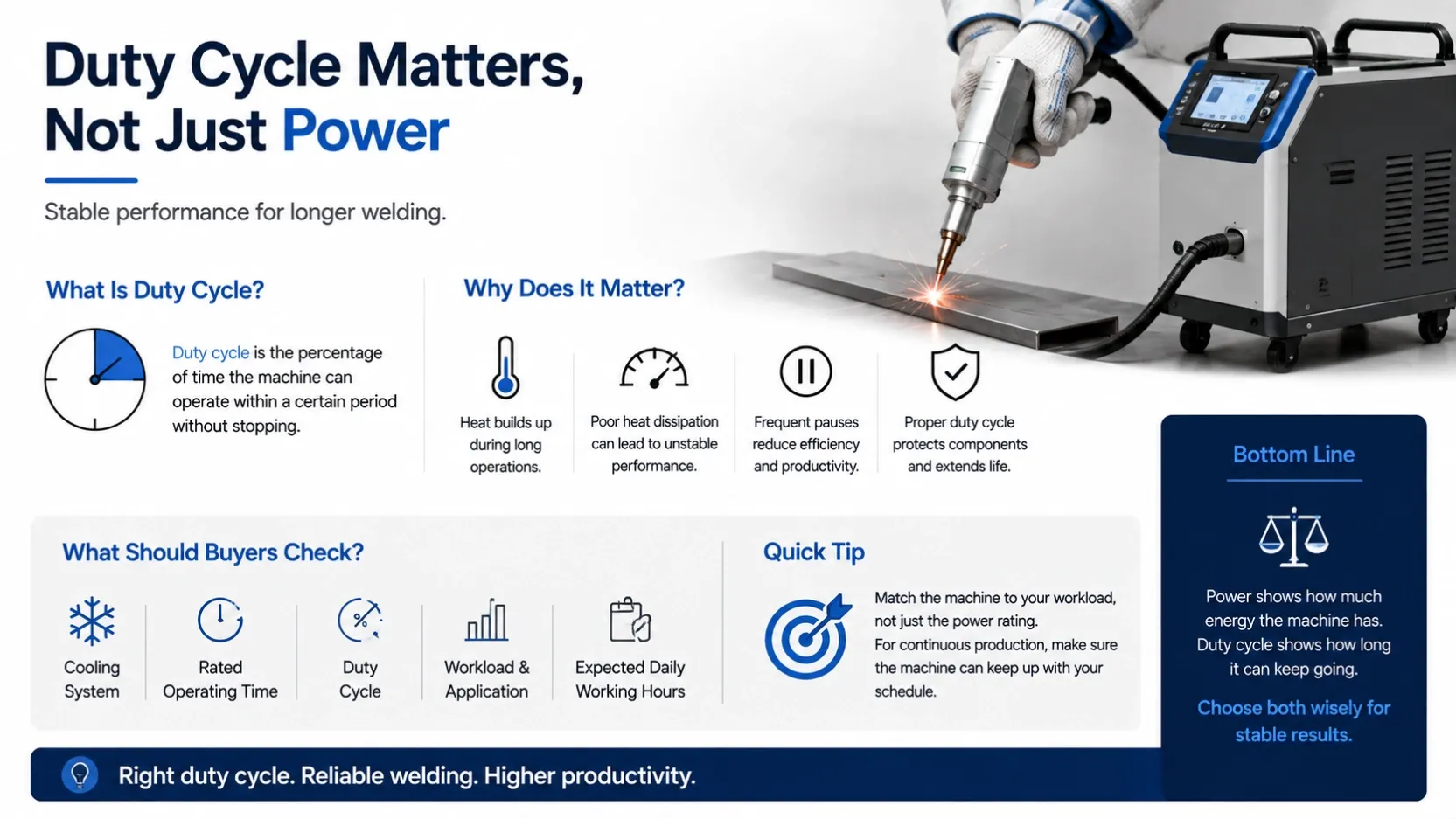
When choosing a handheld laser welding machine, laser power is not the only factor to consider. Duty cycle also affects how the machine performs during longer welding jobs.
What Is Duty Cycle?
Duty cycle refers to how long the machine can operate within a given period before it needs to stop or reduce the workload.
For example, a machine designed for frequent short welding jobs may perform differently from one designed for longer continuous production.
Why Does It Matter?
During long welding operations, heat builds up inside the laser source, cooling system, and other components.
If the machine cannot dissipate heat effectively, continuous operation may lead to:
- Reduced operating stability
- Longer pauses
- Lower production efficiency
- Increased thermal stress on components
What Should Buyers Check?
When comparing machines, don't look at laser power alone.
Also consider:
- Cooling system
- Rated operating time
- Duty cycle
- Production workload
- Expected daily working hours
A machine used for occasional repair work may have very different requirements from one used for daily metal fabrication.
Quick Tip
Match the machine to the workload, not just the power rating.
For frequent production welding, make sure the machine's cooling and operating capability can support your expected working schedule.
Laser power tells you how much energy the machine can deliver, while duty cycle helps show how it can handle continuous work.
Choosing both correctly can help maintain stable operation and production efficiency.