Sep 1, 2026
Why Does Handheld Laser Welding Produce Porosity?
Porosity can affect weld strength and appearance. Discover the key factors behind laser welding pores and practical ways to achieve cleaner, more reliable welds.
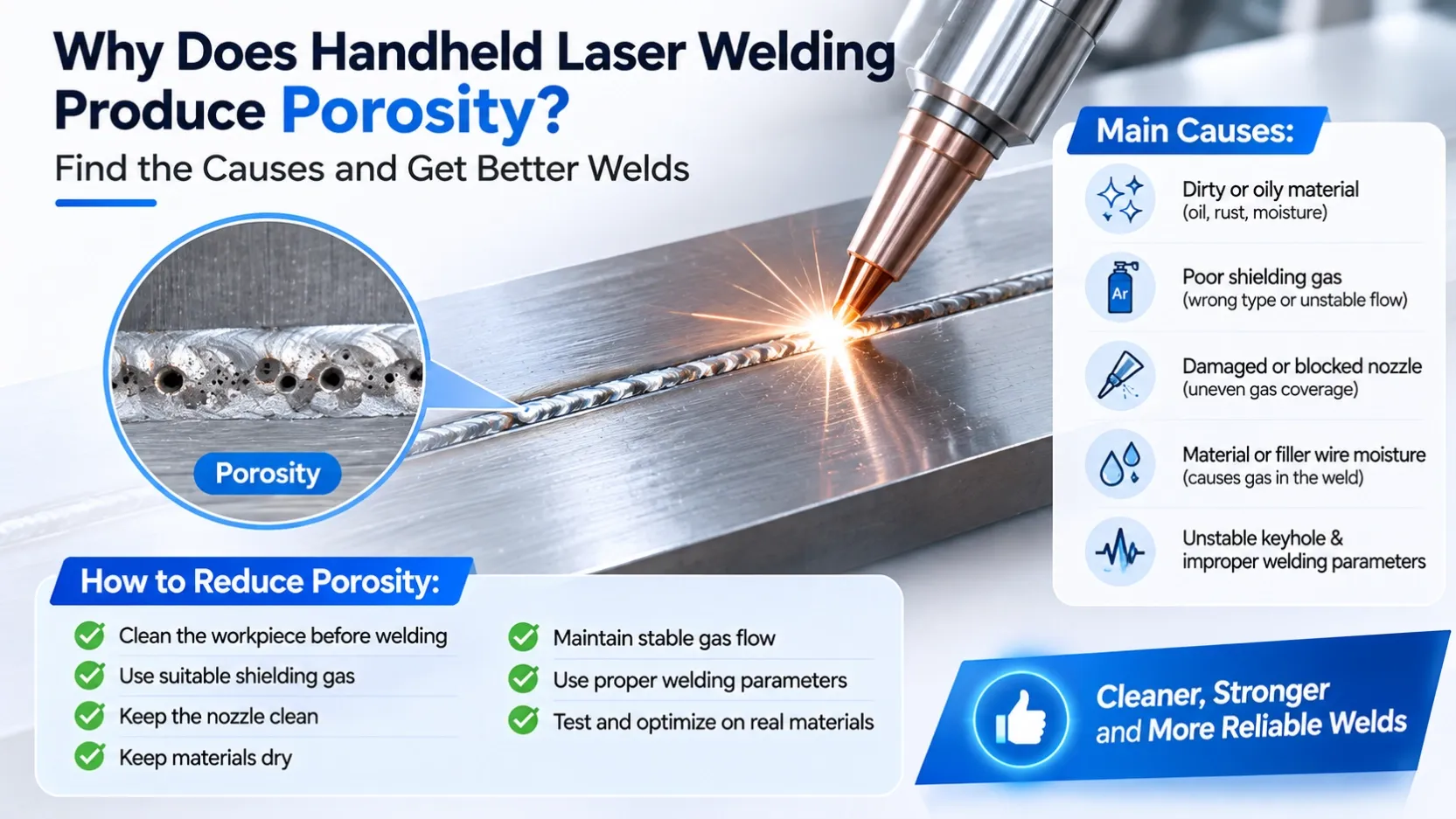
Porosity is one of the most common internal defects that can occur during laser welding.
It appears as small gas-filled holes inside or on the surface of the weld. Sometimes the weld looks acceptable from the outside, but internal pores may still be found during cross-section inspection or X-ray testing.
For manufacturers using Handheld Laser Welding Machines, understanding the source of porosity is important because simply increasing laser power usually does not solve the problem.
The main factors include surface contamination, shielding gas, welding conditions, material moisture, and molten-pool stability.
1. What Causes Porosity in Laser Welding?
Porosity occurs when gas becomes trapped in the molten weld pool before the metal solidifies.
In handheld laser welding, the most common causes are:
- Dirty or oily material
- Moisture on the workpiece
- Contaminated filler wire
- Poor shielding gas coverage
- Incorrect gas flow
- Unstable laser keyhole
- Improper welding parameters
These causes can sometimes occur at the same time, which makes porosity difficult to diagnose by appearance alone.
2. Dirty Material Is a Common Cause
Before welding, the surface should be properly cleaned.
Oil, grease, rust, oxide layers, cutting-fluid residue and moisture can introduce gases or contaminants into the molten pool.
During laser welding, these contaminants can vaporize or react with the molten metal, increasing the risk of trapped gas.
TWI specifically identifies surface contamination and inadequate pre-cleaning as important causes of porosity in laser welds.
Practical solution:
Before welding:
- Remove oil and grease
- Remove visible rust and heavy oxide
- Keep the material dry
- Clean the joint area thoroughly
- Avoid touching the prepared surface with dirty gloves
For aluminum in particular, surface preparation can have a significant effect on porosity. Research from TWI found that material cleanliness was an important factor in reducing coarse porosity.
3. Check the Shielding Gas
Shielding gas protects the molten weld pool from atmospheric contamination.
If gas coverage is insufficient, oxygen, nitrogen or moisture from the surrounding atmosphere can enter the molten pool and contribute to porosity.
But more gas is not always better.
An excessively high flow can create turbulence and disturb the shielding zone, while insufficient flow may fail to protect the weld pool adequately. TWI notes that both excessively high and low gas flow conditions can contribute to porosity.
Check these points:
- Is the gas supply stable?
- Is the gas suitable for the material?
- Is the gas hose leaking?
- Is the nozzle partially blocked?
- Is the gas flow stable?
- Is there strong airflow around the welding area?
4. Check the Nozzle and Gas Coverage
The welding nozzle does more than guide the welding process—it also helps deliver shielding gas to the molten pool.
If the nozzle is damaged, contaminated or partially blocked by spatter, gas coverage can become uneven.
This may result in:
- Oxidized welds
- Unstable weld appearance
- Increased porosity
- Inconsistent welding quality
Therefore, the nozzle should be inspected regularly and replaced when its condition affects gas coverage.
5. Moisture Can Also Cause Problems
Moisture is another factor that should not be overlooked.
Water or moisture can come from:
- Wet workpieces
- Humid storage conditions
- Damp filler wire
- Contaminated surfaces
- Improperly stored materials
For materials and applications that are particularly sensitive to hydrogen-related porosity, keeping the workpiece and filler material clean and dry is especially important. TWI research on aluminum laser welding also highlights the importance of low-moisture shielding gas and proper cleaning.
6. Unstable Keyhole Can Create Internal Porosity
High-power laser welding can create a narrow vapor-filled cavity called a keyhole.
For stable welding, the keyhole needs to remain sufficiently stable while the molten metal flows around it.
If the keyhole becomes unstable and collapses irregularly, gas bubbles can become trapped inside the solidifying weld.
This means that porosity is not always caused by contamination or shielding gas alone.
Laser power, welding speed, focus conditions and other process parameters can also influence keyhole stability.
7. Don't Solve Porosity by Simply Increasing Laser Power
When operators see welding defects, a common reaction is to increase laser power.
However, porosity is not necessarily a problem caused by insufficient power.
If the actual problem is:
Dirty material → More power will not clean the surface.
Poor gas coverage → More power will not improve shielding.
Blocked nozzle → More power will not restore gas flow.
Unstable keyhole → More power may even change the welding condition in an undesirable way.
A better approach is to identify the actual cause first.
A Practical Porosity Troubleshooting Sequence
When porosity appears, check the following in order:
Step 1 — Check the Material
Clean the welding area and make sure there is no oil, moisture, rust or excessive oxide.
Step 2 — Check the Filler Wire
Make sure the wire is clean, dry and suitable for the base material.
Step 3 — Check the Gas
Inspect the gas supply, hose, connections and flow stability.
Step 4 — Check the Nozzle
Make sure the nozzle is clean, undamaged and not blocked by spatter.
Step 5 — Check the Welding Environment
Avoid strong airflow that can disturb shielding gas coverage.
Step 6 — Check Welding Parameters
If the basic conditions are correct, review laser power, welding speed, focus and other process parameters.
This sequence helps avoid changing multiple variables unnecessarily.
How to Reduce Porosity in Handheld Laser Welding
For more consistent welding results:
- Clean the workpiece before welding
- Keep materials and filler wire dry
- Use suitable shielding gas
- Maintain stable gas coverage
- Keep the welding nozzle clean
- Avoid strong drafts around the welding area
- Use appropriate welding parameters
- Test parameters on the actual material
- Inspect weld quality during production
Porosity in Handheld Laser Welding is usually a process-control problem rather than simply a power problem.
Material cleanliness, moisture, shielding gas, nozzle condition and keyhole stability can all affect pore formation.
When porosity appears, don't immediately increase laser power. Instead, check the material → filler wire → shielding gas → nozzle → working environment → welding parameters step by step.
A systematic troubleshooting process can help manufacturers reduce welding defects, improve consistency, and achieve more reliable Handheld Laser Welding results.