Jul 27, 2026
What Materials Can Be Welded with a Handheld Laser Welder?
Learn what materials can be welded with a handheld laser welder. Discover the best applications for stainless steel, carbon steel, aluminum, and galvanized steel, plus welding tips for better results.
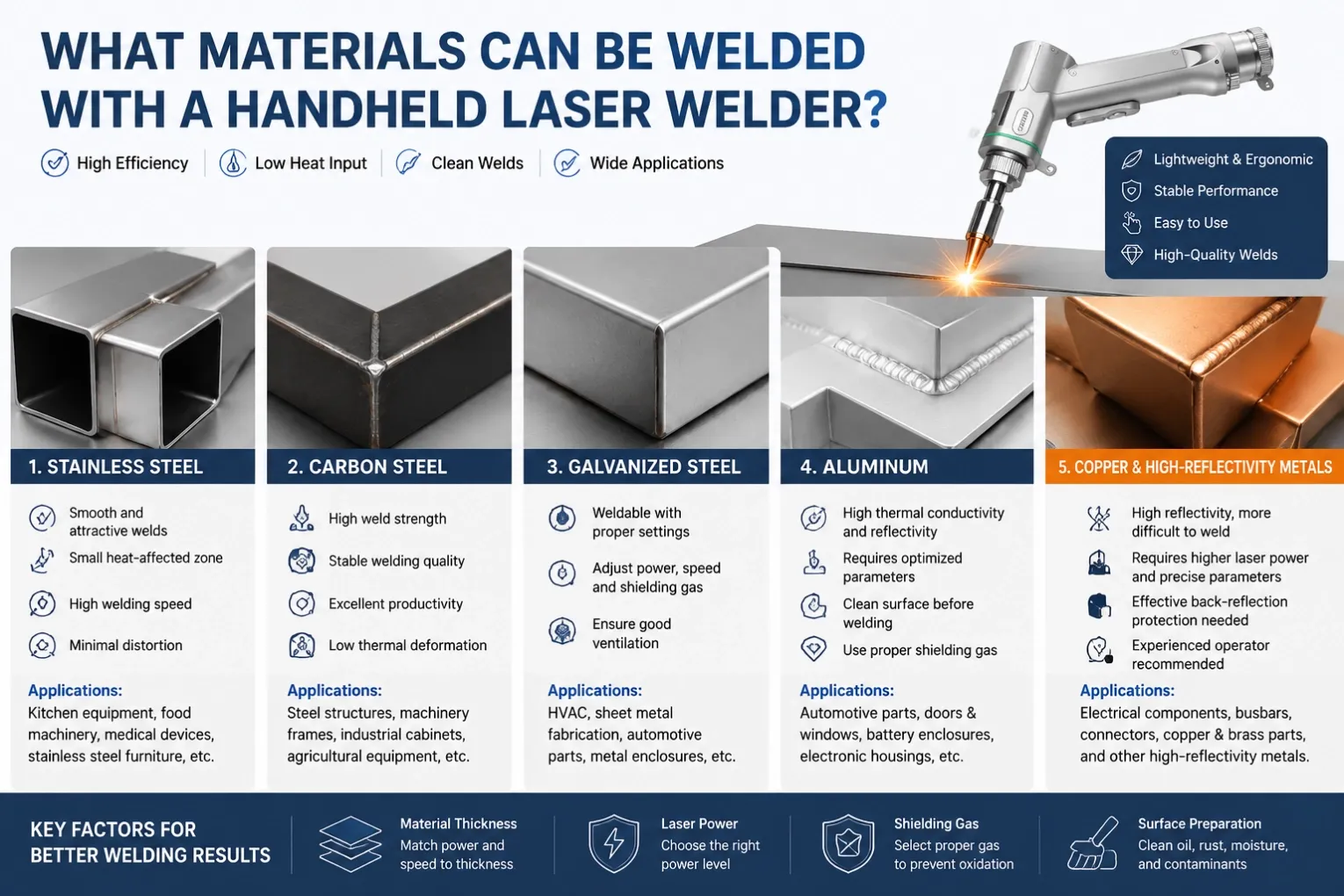
Handheld laser welding has become one of the fastest-growing welding technologies in the metal fabrication industry. Compared with traditional TIG and MIG welding, it offers higher efficiency, lower heat input, smaller heat-affected zones, and cleaner weld seams.
However, not every metal behaves the same during laser welding. Different materials have different thermal conductivity, reflectivity, and melting characteristics, which means welding parameters must be adjusted accordingly.
In this guide, we'll look at the most common materials used in handheld laser welding and what you should consider before welding each one.
1. Stainless Steel
Stainless steel is one of the most suitable materials for handheld laser welding.
Because of its stable metallurgical properties, stainless steel can produce smooth, attractive welds with minimal deformation. In many applications, post-weld grinding or polishing is significantly reduced.
Typical Applications
- Kitchen equipment
- Food processing machinery
- Medical equipment
- Decorative metal products
- Stainless steel furniture
Advantages
- Smooth and aesthetically pleasing welds
- Small heat-affected zone (HAZ)
- High welding speed
- Minimal distortion
- Reduced post-processing
2. Carbon Steel
Carbon steel is another material widely used with handheld laser welders.
Laser welding produces strong, reliable joints while maintaining high production efficiency, making it an excellent choice for industrial manufacturing and structural fabrication.
Typical Applications
- Steel structures
- Machinery frames
- Industrial cabinets
- Agricultural equipment
- Metal fabrication
Advantages
- High weld strength
- Stable welding quality
- Excellent productivity
- Low thermal deformation
3. Galvanized Steel
Galvanized steel can also be welded using handheld laser welding technology.
Because the zinc coating vaporizes at high temperatures, improper welding parameters may lead to spatter or weld defects. Optimizing laser power, welding speed, and shielding gas is essential for achieving consistent welding quality.
Recommended Practices
- Adjust laser power according to material thickness
- Optimize welding speed
- Ensure adequate ventilation
- Use appropriate shielding gas
4. Aluminum
Aluminum is more challenging than stainless steel because of its high thermal conductivity and high laser reflectivity.
Modern fiber laser welding machines can successfully weld many aluminum alloys, but stable results require optimized process parameters and proper welding techniques.
Typical Applications
- Automotive components
- Aluminum doors and windows
- Battery enclosures
- Electronic housings
- Lightweight structural parts
Best Practices
- Thoroughly clean the material surface before welding
- Select the appropriate laser power
- Optimize welding speed
- Use suitable shielding gas to minimize oxidation
5. Copper and Other High-Reflectivity Metals
Copper, brass, and certain copper alloys are classified as high-reflectivity materials.
These metals reflect a significant portion of laser energy, making them more difficult to weld than stainless steel or carbon steel.
Successful welding generally requires:
- Higher laser power
- Optimized welding parameters
- Effective back-reflection protection
- Experienced operators
Before welding high-reflectivity materials, manufacturers should ensure that the laser welding system is capable of handling these demanding applications.
Key Factors That Affect Welding Quality
Excellent welding results depend not only on the material but also on several important process factors.
Material Thickness
Different material thicknesses require different laser power levels and welding speeds.
Laser Power
Higher power is generally required for thicker materials or metals with high thermal conductivity.
Shielding Gas
Selecting the proper shielding gas helps reduce oxidation, improve weld appearance, and enhance welding stability.
Surface Preparation
Oil, rust, moisture, oxide layers, and other contaminants should be removed before welding to reduce porosity and improve weld quality.
Handheld laser welding is an efficient and versatile solution for joining a wide range of metals, particularly stainless steel, carbon steel, and galvanized steel.
Materials such as aluminum and copper can also be welded, but they require more precise parameter control, suitable equipment, and optimized welding techniques due to their higher reflectivity and thermal conductivity.
Understanding the characteristics of different materials and selecting the appropriate welding parameters are the keys to achieving strong, clean, and consistent welds.