Sep 9, 2026
How to Choose the Right Filler Wire Diameter for Handheld Laser Welding?
Choosing the right filler wire diameter helps improve weld stability and bead formation. Compare 0.8–1.6 mm options based on material thickness, joint gap, and filling requirements.
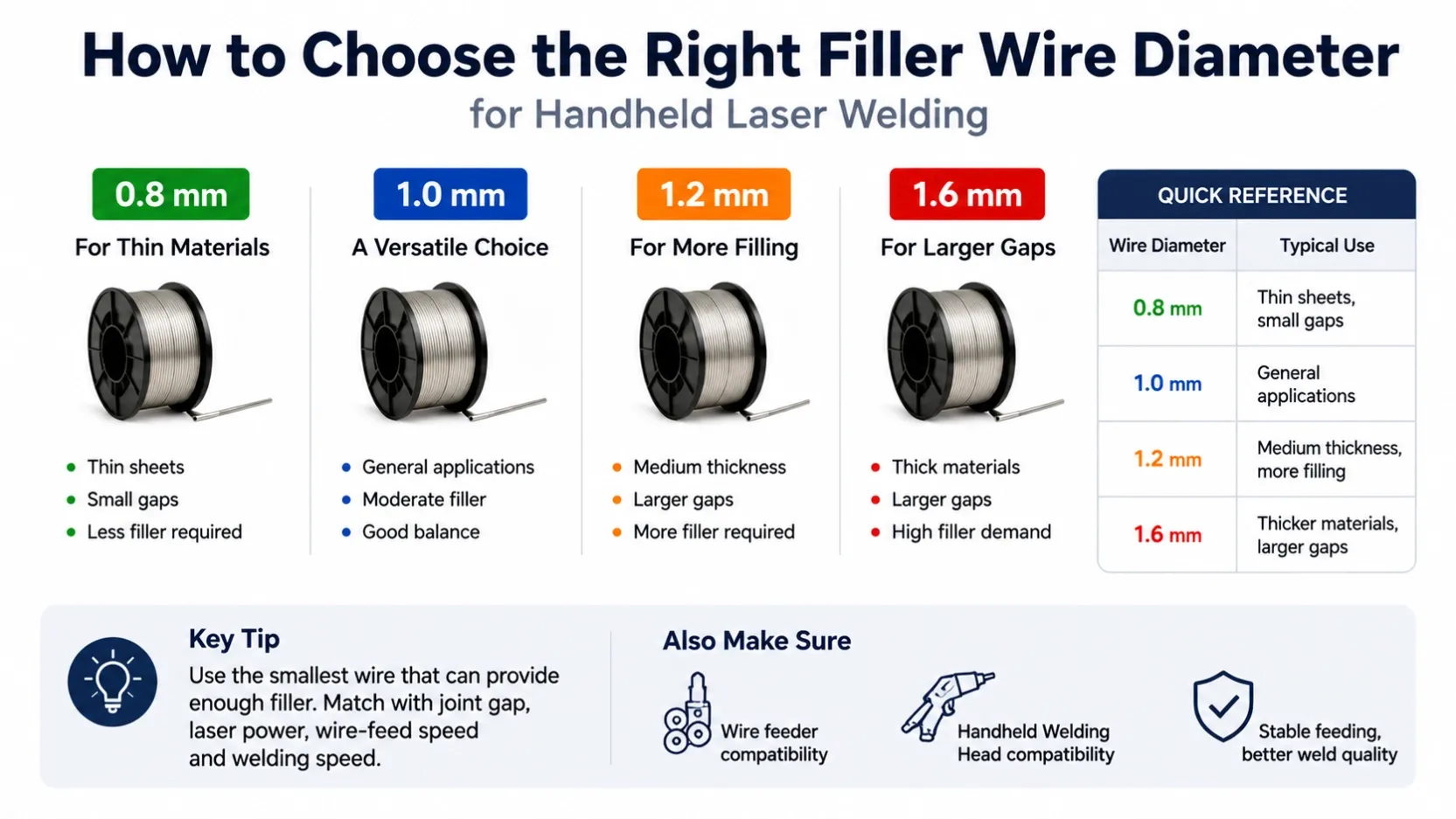
Choosing the right filler wire is important for getting a stable weld bead. A wire that is too large may not melt properly, while a wire that is too small may not provide enough filler.
0.8 mm — For Thin Materials
Suitable for thin sheets, small gaps, and applications requiring a smaller amount of filler.
1.0 mm — A Versatile Choice
A practical option for many general handheld laser welding applications, especially when moderate filler is required.
1.2 mm — For More Filling
Suitable for medium-thickness materials or joints with larger gaps that require more filler metal.
1.6 mm — For Larger Gaps
More suitable for thicker materials or joints requiring a larger amount of filler.
Quick Reference
Wire Diameter | Typical Use |
|---|---|
0.8 mm | Thin sheets, small gaps |
1.0 mm | General applications |
1.2 mm | Medium thickness, more filling |
1.6 mm | Thicker materials, larger gaps |
Don't Choose by Thickness Alone
Wire diameter should also match the joint gap, laser power, wire-feed speed, and welding speed.
A simple starting rule is:
Use the smallest wire that can provide enough filler for the joint.
Also make sure the wire feeder, guide, and Handheld Welding Head are compatible with the selected wire diameter.
Final Takeaway
The right filler wire can improve weld stability and bead formation. 0.8–1.0 mm is often suitable when less filler is needed, while 1.2–1.6 mm can provide more filling capacity for larger gaps and thicker workpieces.