Jul 29, 2026
Laser Welding vs. TIG Welding: Why More Manufacturers Are Choosing Handheld Laser Welding Machines
Learn why Handheld Laser Welding Machines are replacing TIG welding. Explore their advantages in welding speed, precision, productivity, lower heat input, and long-term savings.
In today's manufacturing industry, improving productivity while maintaining high-quality welds has become a top priority. As a result, more companies are replacing traditional TIG welding with Handheld Laser Welding Machines.
While TIG welding has been a trusted process for many years, handheld laser welding offers significant advantages in terms of speed, efficiency, weld quality, and operating costs. For many fabrication businesses, switching to laser welding is not only a technological upgrade but also a smart investment for long-term growth.
In this article, we'll compare the two welding methods and explain why more manufacturers are choosing Handheld Laser Welding Machines.
What Is a Handheld Laser Welding Machine?
A Handheld Laser Welding Machine uses a high-energy fiber laser beam to melt and fuse metal materials. The laser delivers concentrated energy directly to the weld area, creating a narrow, clean, and precise weld with minimal heat input.
Compared with traditional welding methods, handheld laser welding requires less post-processing, produces less distortion, and significantly improves production efficiency.
It is widely used in:
- Sheet metal fabrication
- Stainless steel products
- Kitchen equipment
- Metal furniture
- Automotive components
- Machinery manufacturing
- Elevator production
What Is TIG Welding?
TIG (Tungsten Inert Gas) welding is a conventional arc welding process that uses a tungsten electrode and shielding gas to create the weld.
It is well known for producing high-quality welds, especially on thin materials. However, TIG welding usually requires experienced operators, slower welding speeds, and more finishing work after welding.
For manufacturers focused on productivity and cost efficiency, these limitations have encouraged the adoption of handheld laser welding technology.
Why Handheld Laser Welding Machines Are Replacing TIG Welding
1. Up to 3–10 Times Faster Welding Speed
One of the biggest advantages of a Handheld Laser Welding Machine is its exceptional speed.
Compared with TIG welding, laser welding can be several times faster, depending on the material and application. Higher welding speed means:
- Increased production capacity
- Shorter delivery times
- Reduced labor hours
- Improved manufacturing efficiency
For businesses handling large production volumes, this productivity improvement can significantly reduce manufacturing costs.
2. Cleaner Welds with Less Finishing
Laser welding produces a concentrated and stable weld pool, resulting in smooth and uniform weld seams.
Compared with TIG welding, manufacturers often spend much less time on:
- Grinding
- Polishing
- Surface finishing
This not only saves labor but also improves the appearance of finished products.
3. Minimal Heat Input and Less Distortion
Because laser energy is highly concentrated, only a small area around the weld is heated.
Benefits include:
- Smaller heat-affected zone
- Minimal material deformation
- Better dimensional accuracy
- Lower risk of burn-through
This is especially important when welding thin stainless steel sheets and precision components.
4. Easier to Learn and Operate
Traditional TIG welding requires operators to coordinate the welding torch, filler wire, current, and travel speed simultaneously.
A Handheld Laser Welding Machine simplifies this process.
With proper parameter settings, new operators can usually become productive after a relatively short training period, helping manufacturers reduce training costs and labor dependency.
5. Lower Overall Operating Costs
Although the initial investment in a Handheld Laser Welding Machine is generally higher than TIG equipment, the long-term operating costs are often lower.
Manufacturers can benefit from:
- Higher production efficiency
- Reduced labor costs
- Less grinding and polishing
- Lower material deformation
- Less rework
- Higher product consistency
For companies with continuous production, these savings can provide an attractive return on investment over time.
6. Excellent Welding Quality
Handheld laser welding delivers consistent weld quality across a wide range of applications.
Typical advantages include:
- Smooth weld appearance
- Deep penetration
- Stable weld strength
- Minimal porosity
- Low spatter
- Reduced oxidation
These characteristics make it suitable for industries where appearance and precision are equally important.
7. Wide Range of Material Applications
Modern Handheld Laser Welding Machines can weld many commonly used metals, including:
- Stainless Steel
- Carbon Steel
- Mild Steel
- Galvanized Steel
- Aluminum alloys (with appropriate parameters)
This versatility allows manufacturers to handle different production requirements using a single machine.
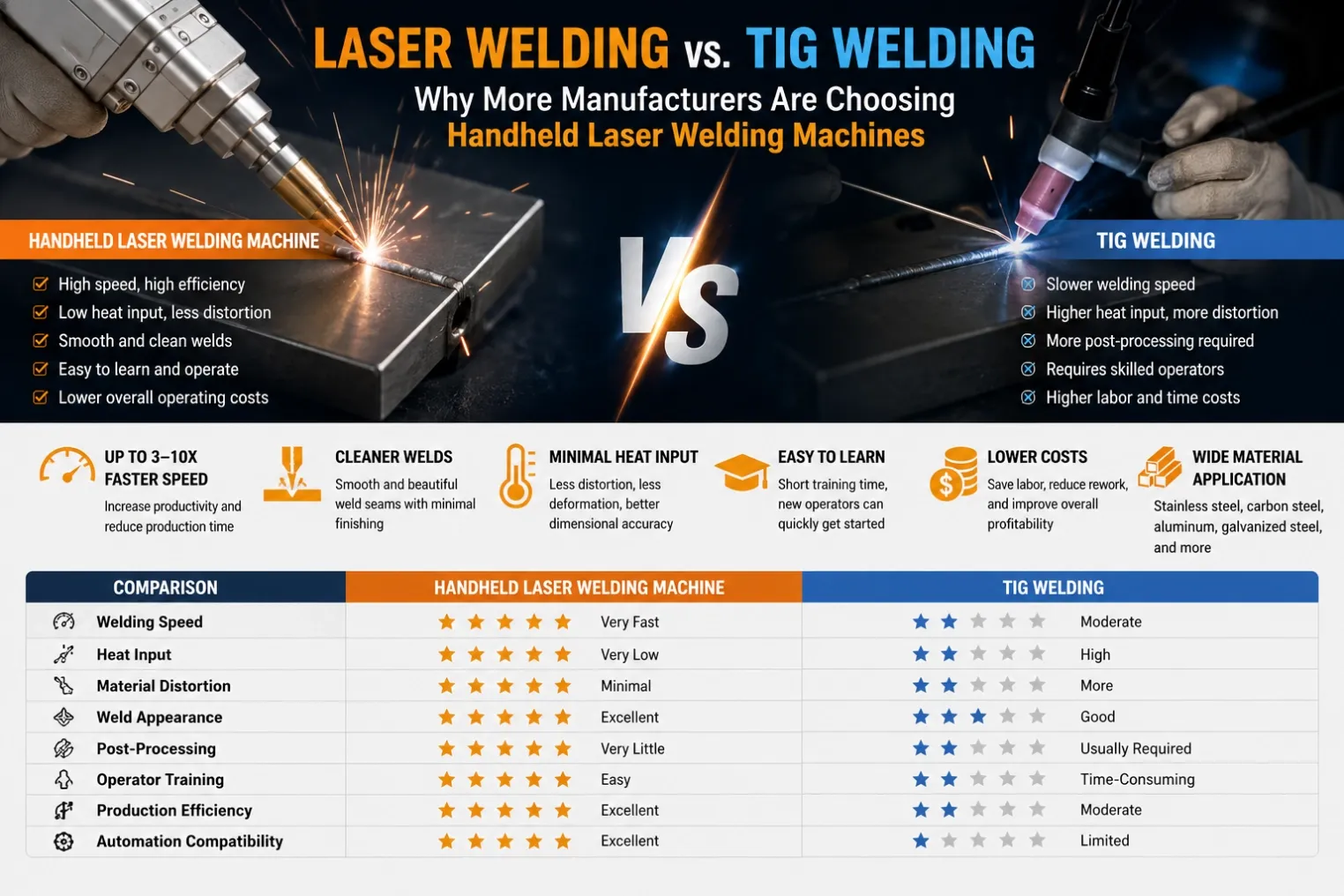
Laser Welding vs. TIG Welding Comparison
Feature | Handheld Laser Welding Machine | TIG Welding |
|---|---|---|
Welding Speed | ★★★★★ | ★★☆☆☆ |
Heat Input | Very Low | High |
Material Distortion | Minimal | Moderate |
Weld Appearance | Excellent | Good |
Post-Processing | Very Little | Usually Required |
Operator Training | Easy | Time-Consuming |
Production Efficiency | Excellent | Moderate |
Automation Compatibility | Excellent | Limited |
Is a Handheld Laser Welding Machine Right for Your Business?
If your business values:
- Higher productivity
- Better weld quality
- Lower labor costs
- Faster delivery
- Cleaner weld appearance
- Reduced post-processing
- Consistent production quality
then investing in a Handheld Laser Welding Machine can be a practical choice.
It is particularly suitable for manufacturers involved in sheet metal fabrication, kitchen equipment, metal furniture, automotive components, machinery production, and stainless steel processing.
Both laser welding and TIG welding remain effective joining methods, but the needs of modern manufacturing are changing.
As manufacturers seek greater efficiency, consistent quality, and lower operating costs, Handheld Laser Welding Machines have become the preferred solution for many fabrication businesses.
By combining high welding speed, minimal distortion, clean weld seams, easy operation, and lower long-term production costs, handheld laser welding helps companies improve competitiveness while meeting increasing market demands.