Aug 21, 2026
How to Improve Handheld Laser Welding Efficiency in Production?
Improve Handheld Laser Welding efficiency with the right power, speed, operation, and consumable maintenance for faster production and consistent weld quality.
For manufacturers, welding quality is important, but welding efficiency is equally critical. A high-quality Handheld Welding Machine can help reduce welding time, improve consistency, and lower overall production costs.
However, simply increasing laser power does not always mean higher productivity. Welding efficiency depends on several factors, including welding speed, preparation, parameters, wire feeding, operator technique, and equipment maintenance.
So, how can manufacturers improve the efficiency of handheld laser welding?
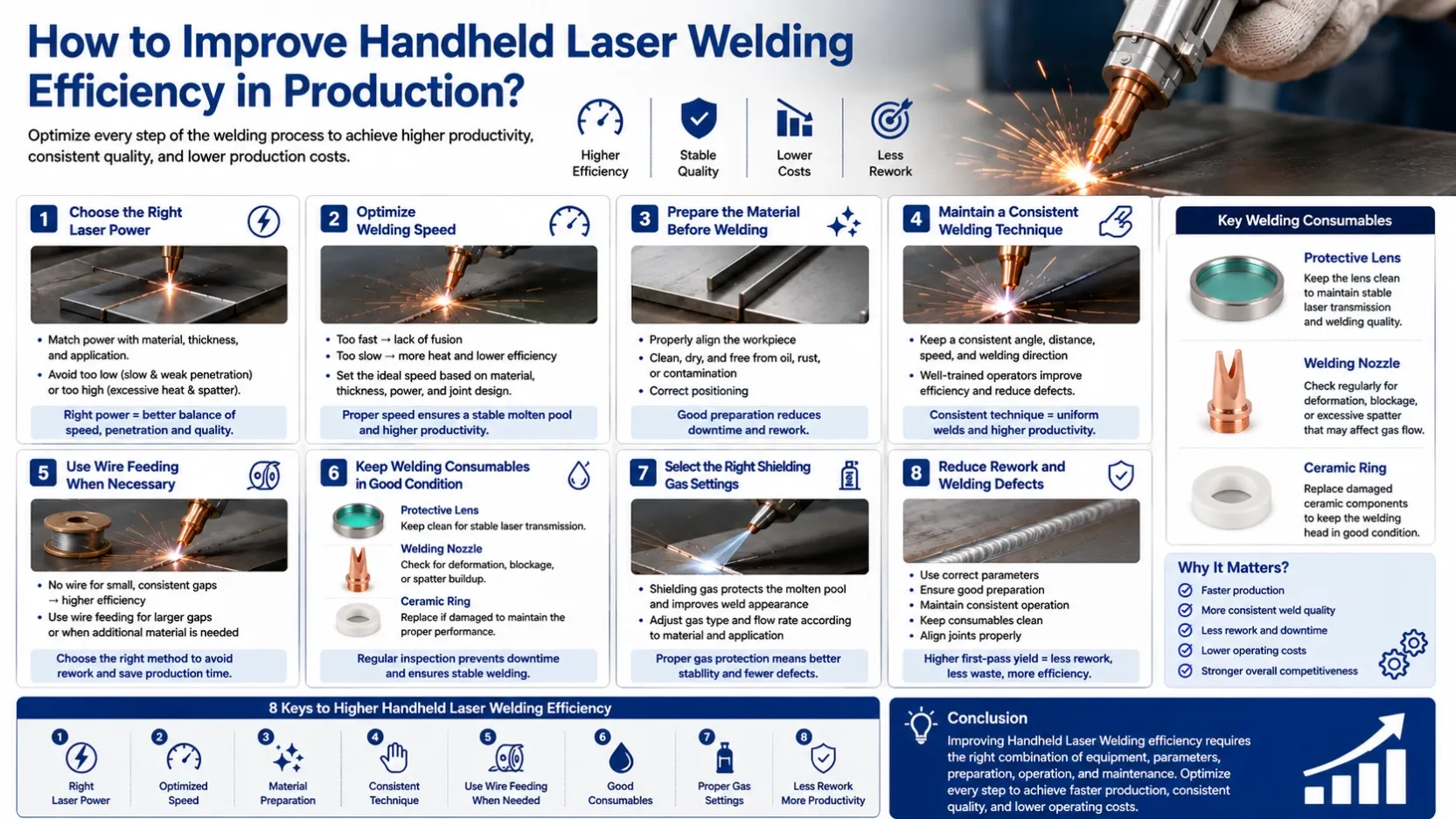
1. Choose the Right Laser Power
Laser power should match the material type, thickness, and welding application.
Using insufficient power may require slower movement and multiple passes, while excessive power can increase heat input and cause unnecessary spatter or deformation.
Choosing the appropriate power helps achieve a good balance between welding speed, penetration, and weld quality.
2. Optimize Welding Speed
Welding speed has a direct impact on production efficiency.
A suitable welding speed can help maintain a stable molten pool while reducing unnecessary heat input.
However, welding too quickly may result in insufficient fusion, while welding too slowly can increase production time and heat accumulation.
The ideal speed should therefore be determined according to the material, thickness, laser power, and joint design.
3. Prepare the Material Before Welding
Proper material preparation can significantly reduce unnecessary downtime.
Before welding, make sure that the workpiece is:
- Properly aligned
- Clean and dry
- Free from excessive oil, rust, or contamination
- Correctly positioned
Good preparation reduces rework and helps the operator maintain a stable welding process.
4. Maintain a Consistent Welding Technique
Because a Handheld Laser Welding Machine is operated manually, operator technique can have a major impact on productivity.
Maintaining a consistent:
- Welding angle
- Working distance
- Movement speed
- Welding direction
can help produce more uniform welds and reduce defects.
With proper training, operators can also reduce unnecessary movements and improve overall production efficiency.
5. Use Wire Feeding When Necessary
Not every application requires filler wire.
For suitable joints with a small and consistent gap, welding without filler wire can be highly efficient.
However, when the joint gap is larger or additional material is required, laser welding with wire feeding can provide better results.
Choosing the right welding method according to the joint condition can help avoid unnecessary rework.
6. Keep Welding Consumables in Good Condition
Worn or contaminated consumables can affect welding performance and increase downtime.
Regularly inspect:
Protective Lens
Keep the protective lens clean to maintain stable laser transmission.
Welding Nozzle
Check for deformation, blockage, or excessive spatter that may affect shielding gas flow.
Ceramic Ring
Replace damaged ceramic components to maintain the proper working condition of the welding head.
Regular maintenance can reduce unexpected interruptions and help keep production running smoothly.
7. Select the Right Shielding Gas Settings
Shielding gas protects the molten pool during welding and can affect weld appearance and stability.
Insufficient gas protection may cause oxidation and welding defects, while inappropriate gas flow can also affect the welding process.
The gas type and flow rate should be adjusted according to the material and welding application.
8. Reduce Rework and Welding Defects
One of the most effective ways to improve productivity is to reduce rework.
Common causes of rework include:
- Incorrect welding parameters
- Poor material preparation
- Inconsistent operation
- Contaminated consumables
- Improper joint alignment
A stable welding process helps manufacturers achieve higher first-pass yield, reducing the time and material wasted on repairs.
Practical Tips for Higher Welding Efficiency
To improve the performance of a Handheld Welding Machine, manufacturers should:
- Select suitable laser power
- Optimize welding speed
- Prepare and align materials properly
- Maintain consistent operator technique
- Use filler wire when required
- Keep welding consumables clean
- Check shielding gas regularly
- Minimize rework and unnecessary downtime
Improving Handheld Laser Welding efficiency is not simply about using higher laser power. The best results come from combining the right equipment, suitable welding parameters, proper material preparation, skilled operation, and regular maintenance.
By optimizing the complete welding process, manufacturers can achieve faster production, more consistent weld quality, less rework, and lower operating costs.
A properly configured and maintained Handheld Welding Machine can become an efficient solution for a wide range of industrial welding applications.