Sep 3, 2026
How Does Weld Joint Type Affect Handheld Laser Welding?
Joint design plays an important role in handheld laser welding. See how different joint types affect penetration, weld formation, and parameter selection for better welding results.
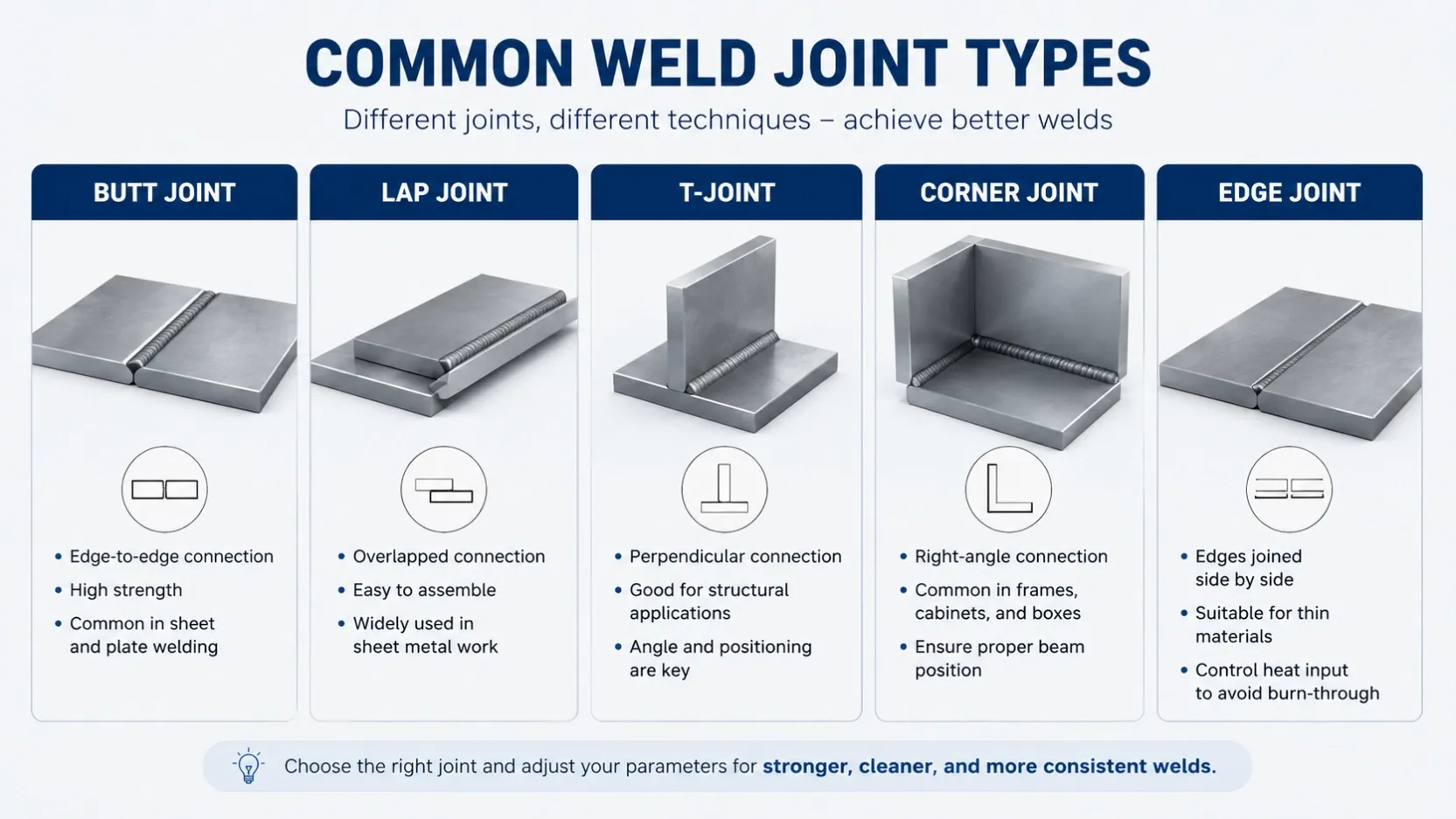
When laser welding looks good on one joint but fails on another, the problem may not be your laser power—it could be the joint type.
Butt joints, lap joints, T-joints, and corner joints distribute laser energy differently. Using the same settings for every joint can easily lead to poor penetration, uneven welds, or burn-through.
So, how should you adjust your welding approach?
1. Butt Joint — Focus on Penetration
Butt joints are commonly used for metal sheets and plates.
The key factors are:
- Joint gap
- Focus position
- Laser power
- Welding speed
A small, consistent gap usually makes laser welding easier. If the gap becomes too large, filler wire may be needed to achieve proper fusion.
Tip: Always check the actual gap before changing the laser power.
2. Lap Joint — Make Sure Both Sheets Fuse
Lap joints are widely used in sheet-metal fabrication.
The laser needs to melt the upper sheet sufficiently to connect with the lower sheet. If the energy is too low, the two sheets may not fuse properly.
Pay attention to:
Power + speed + focus + overlap width
Simply increasing power is not always the best solution.
3. T-Joint — Welding Angle Matters
T-joints are common in frames, brackets, cabinets, and other metal structures.
Unlike flat welding, the Handheld Welding Head angle has a direct influence on where the laser energy enters the joint.
An incorrect angle can cause:
- Uneven penetration
- One-sided fusion
- Excessive spatter
- Poor root fusion
For T-joints, check the welding angle before changing the power.
4. Corner Joint — Keep the Beam in the Right Position
Corner welding looks simple, but positioning can be tricky.
If the laser is too close to one side, one workpiece may receive too much energy while the other receives too little.
This can result in an uneven weld bead or incomplete fusion.
A small test weld is recommended before production.
5. Edge Joint — Avoid Too Much Heat
Edge joints have less material around the welding area, especially when working with thin sheets.
Too much heat can quickly cause:
- Edge melting
- Burn-through
- Deformation
- Uneven welds
For thin materials, power and welding speed should be carefully balanced.
Why Can't One Parameter Set Fit Every Joint?
This is where many beginners make mistakes.
Even with the same material and thickness, changing from a butt joint to a lap or T-joint can change the welding result.
The reason is simple:
Different joint geometries change the way laser energy enters and spreads through the material.
Your Handheld Welding Head, laser source, focus, welding angle, and wobble settings all work together.
Common Handheld Welding Head brands include SUP, Qilin, Raytools, Relfar, IPG, WSX, Hanwei, Bodor, and Ospri.
A Simple Rule Before Production
Before welding a new joint type, don't immediately change everything.
Try this:
Check the joint → Set the focus → Start with a test weld → Check penetration → Adjust power and speed
This simple process can save time and reduce unnecessary parameter adjustments.
Different joints need different welding strategies.
Before blaming the laser source or increasing the power, check the joint type, gap, focus, and welding angle first.
The right combination of Handheld Welding Head, laser source, and welding parameters is the key to achieving a stable weld.