Aug 25, 2026
How Does Joint Gap Affect Handheld Laser Welding?
Learn how joint gap affects handheld laser welding quality and how proper gap control helps achieve stronger, more stable welds.
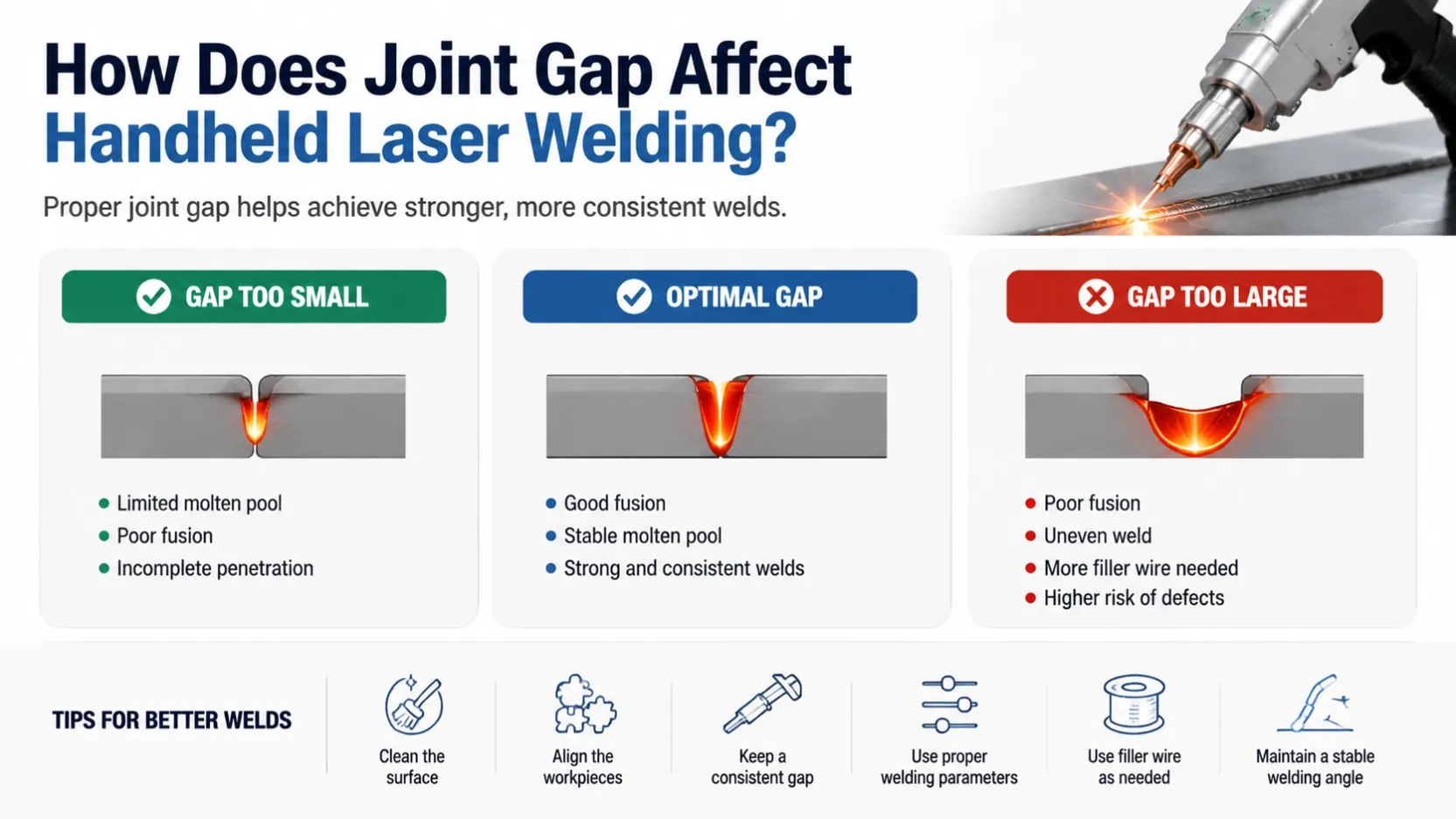
In Handheld Laser Welding, the gap between two metal parts can have a significant effect on weld quality.
Laser welding uses a concentrated heat source, so it generally works best when the materials are properly fitted together. If the joint gap is too large, the laser energy may not be distributed effectively across the joint, resulting in poor fusion, uneven welds, or excessive filler wire consumption.
Understanding how joint gap affects the welding process can help operators achieve more consistent results.
1. Why Does Joint Gap Matter?
A laser beam has a relatively small and concentrated heat-affected area.
When two metal pieces fit closely together, the laser can efficiently melt the edges and form a stable molten pool.
However, when there is a large gap between the materials, the laser may not be able to bridge the gap effectively.
This can lead to:
- Poor fusion
- Incomplete welding
- Uneven weld appearance
- Excessive filler wire
- Increased risk of burn-through
Therefore, joint preparation and fit-up are important parts of laser welding quality.
2. What Happens When the Gap Is Too Small?
A small and consistent gap is generally easier to control.
When the materials are positioned correctly, the laser can concentrate its energy around the joint and create a more stable molten pool.
However, extremely tight joints are not always necessary for every application.
The appropriate joint design depends on:
- Material type
- Material thickness
- Laser power
- Welding speed
- Welding head
- Joint configuration
The goal is to maintain a consistent and controllable joint, rather than simply making the gap as small as possible.
3. What Happens When the Gap Is Too Large?
A larger gap makes laser welding more challenging.
If the laser beam cannot effectively bridge the joint, the molten metal may not completely connect both sides of the workpiece.
Common symptoms include:
Uneven weld seams
The weld may become wider or irregular.
Insufficient fusion
The two materials may not be properly fused together.
Higher wire consumption
More filler wire may be required to fill the joint.
Unstable welding
The molten pool can become more difficult to control.
For applications with larger gaps, appropriate wobble welding and wire feeding can help improve the ability to fill the joint.
4. Can Handheld Laser Welding Handle Small Gaps?
Yes.
One advantage of handheld laser welding is that the operator can adjust the welding position and movement according to the actual joint condition.
With suitable welding parameters and a proper welding technique, handheld laser welding can handle certain variations in joint fit-up.
However, this does not mean that laser welding can compensate for unlimited gaps.
Good material preparation is still important.
A consistent joint usually provides more predictable welding results than relying on the laser to fill a large or irregular gap.
5. How Does Filler Wire Help?
When a joint has a small gap, filler wire can provide additional material to form the weld.
The operator can control the amount of filler material entering the molten pool while moving the welding gun along the joint.
However, filler wire should not simply be used to compensate for poor material alignment.
If the gap is too large, increasing wire feeding speed may not solve the underlying problem.
Instead, check:
- Material alignment
- Joint design
- Welding angle
- Laser power
- Welding speed
- Wire feeding speed
These factors should be adjusted together.
6. Joint Preparation Is Important
Before welding, make sure the workpieces are properly prepared.
Clean the Surface
Remove oil, moisture, rust, paint, and other contaminants from the welding area.
Align the Workpieces
Make sure the two parts are correctly positioned before welding.
Maintain Consistent Gap
Avoid sections where the gap suddenly becomes larger or smaller.
Check the Edge Condition
Damaged or uneven edges can make the welding process less stable.
Good preparation can reduce the need for excessive parameter adjustments during welding.
7. Different Joint Designs Require Different Approaches
Handheld laser welding can be used for various joint configurations, including:
- Butt joints
- Lap joints
- Corner joints
- T-joints
- Inside corners
- Outside corners
Each joint has a different heat distribution and welding position.
For example, corner welding may require a different welding angle and movement pattern compared with a flat butt joint.
Therefore, operators should adjust the laser parameters, welding angle, wobble pattern, and wire feeding according to the joint design.
8. How to Get More Consistent Laser Welding Results?
For better welding consistency, focus on the complete process rather than only the laser power.
Before welding:
- Clean the material
- Check material alignment
- Maintain a consistent joint gap
- Select suitable welding parameters
- Check the welding nozzle and protective lens
During welding:
- Maintain a stable welding angle
- Keep a consistent working distance
- Control welding speed
- Adjust wire feeding when necessary
- Keep the welding movement stable
Joint gap is an important but sometimes overlooked factor in Handheld Laser Welding.
A controlled and consistent gap helps create a more stable molten pool and more predictable weld formation. When the gap becomes too large, problems such as incomplete fusion, uneven welds, and increased filler wire consumption may occur.
Instead of relying only on higher laser power, manufacturers should pay attention to material preparation, joint design, welding parameters, and filler wire selection.
With proper joint preparation and the right welding settings, handheld laser welding can achieve more stable and consistent results across a wide range of metal fabrication applications.