Aug 26, 2026
Handheld Laser Welding Safety: Essential Rules for Safe Operation
Learn the essential safety practices for handheld laser welding, from laser protection and PPE to equipment checks and safe operation.
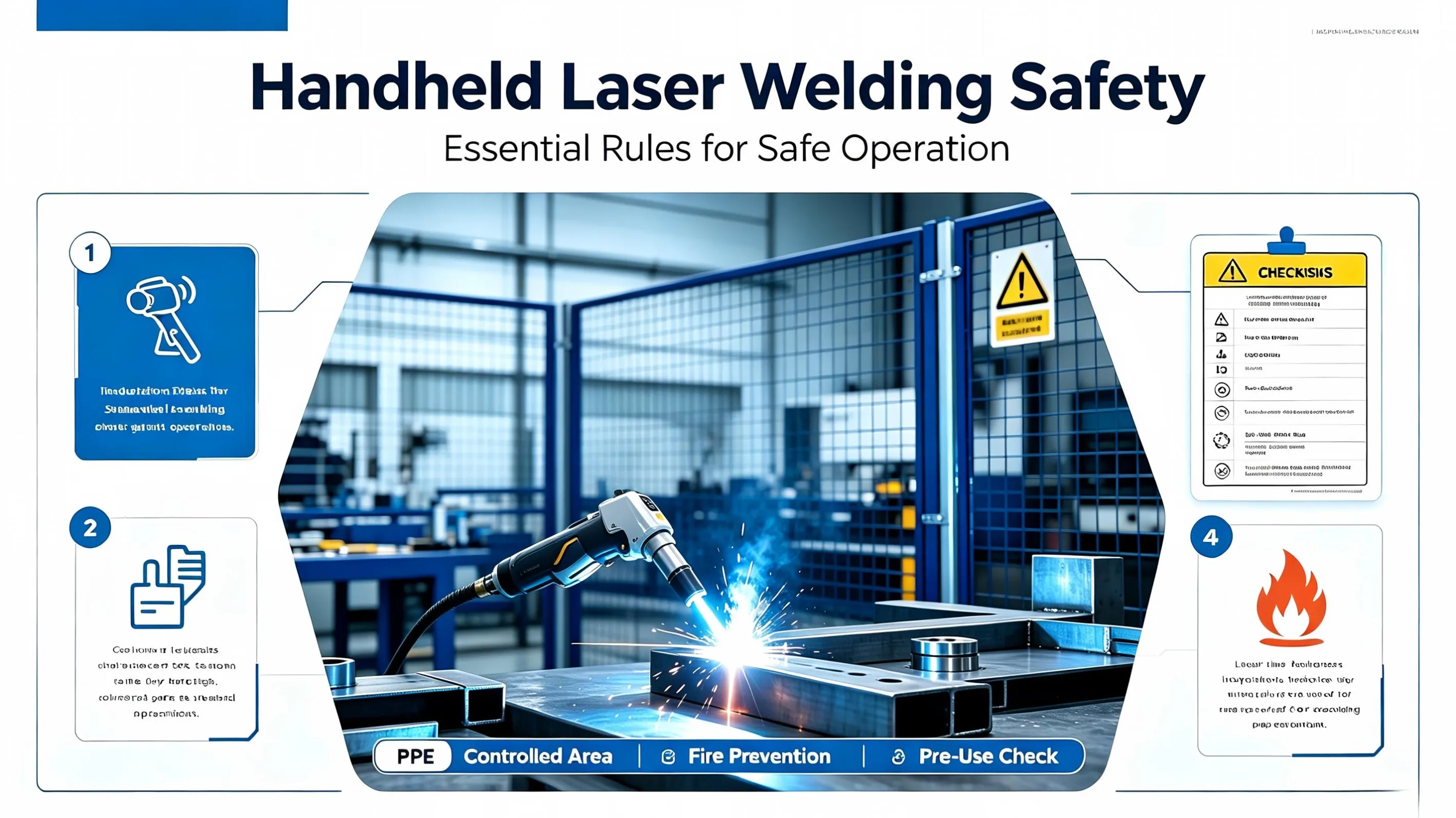
Handheld Laser Welding Machines offer high welding speed, precise heat input, and simple operation. However, unlike traditional welding equipment, handheld laser welders use high-power laser sources that require specific safety measures.
Most industrial handheld laser welding systems operate in the Class 4 laser range. Direct or reflected laser radiation can cause serious eye or skin injuries, while sparks and heat can also create fire hazards.
For this reason, safety should be considered an essential part of the welding process—not an optional feature.
1. Understand the Laser Hazard
The biggest difference between handheld laser welding and traditional arc welding is the type of energy involved.
A high-power laser beam can cause injury not only through direct exposure, but also through reflected or scattered laser radiation.
Reflective metals such as stainless steel, aluminum, and copper require particular attention because laser energy can be reflected from the workpiece.
Operators should understand the laser classification of their equipment and follow the manufacturer's safety requirements.
2. Use a Controlled Welding Area
Handheld laser welding should be performed in a properly controlled area.
A suitable laser-controlled workspace can help prevent people who are not involved in the operation from accidentally entering the hazardous area.
Depending on the installation, safety measures may include:
- Laser safety barriers or enclosures
- Warning signs
- Controlled access
- Appropriate interlocks
- Emergency stop systems
A written laser safety program is also recommended for industrial applications.
3. Wear Appropriate Personal Protective Equipment
Operators should use PPE appropriate for the specific laser wavelength and application.
Laser safety eyewear must be selected according to the laser wavelength and required optical density. Ordinary safety glasses or standard welding goggles should not automatically be assumed to provide laser protection.
Other PPE may include:
- Appropriate protective clothing
- Gloves
- Safety footwear
- Face or skin protection where required
Always follow the equipment manufacturer's recommendations and applicable local regulations.
4. Pay Attention to Reflections
One common misconception is that the laser is only dangerous when the operator looks directly at the beam.
This is not correct.
Laser radiation can be reflected by metal surfaces, tools, fixtures, and other objects in the working area.
Therefore, operators should avoid placing unnecessary reflective objects around the welding area.
Before starting work, check the surrounding workspace and remove materials that could create unwanted reflections.
5. Keep the Welding Area Free of Flammable Materials
Laser welding produces intense heat, sparks, and molten metal.
Paper, plastic, solvents, oil, dust, and other combustible materials should be kept away from the welding area.
Good housekeeping is particularly important when welding inside workshops where multiple processes are operating simultaneously.
A suitable fire-prevention procedure should be established according to the working environment.
6. Check the Machine Before Welding
Before starting the machine, operators should inspect the equipment.
Pay particular attention to:
Welding Head
Check for visible damage and make sure components are properly installed.
Protective Lens
A contaminated or damaged protective lens can affect welding performance and may require immediate replacement.
Cables and Fiber
Check for visible damage, excessive bending, or abnormal wear.
Emergency Stop
Make sure the emergency stop system is accessible and functioning according to the manufacturer's procedures.
Cooling System
For water-cooled systems, check the coolant level and cooling system status before operation.
A simple pre-use inspection can help prevent unnecessary downtime and safety problems.
7. Never Bypass Safety Features
Modern handheld laser welding machines may include safety interlocks, key switches, emergency stops, and other protective functions.
These features should never be bypassed or modified without authorization.
Disabling a safety function may allow the machine to operate under unsafe conditions.
If a safety alarm appears, stop the operation and identify the cause before continuing.
8. Operator Training Is Essential
Handheld laser welding is relatively easy to learn compared with some traditional welding processes, but easy operation does not mean no training is required.
Operators should understand:
- Basic laser hazards
- Machine operation
- Emergency procedures
- PPE requirements
- Work area controls
- Welding head handling
- Basic machine inspection
AWS notes that the growing use of handheld laser systems makes proper training and safety procedures increasingly important.
9. Follow the Manufacturer's Safety Instructions
Different handheld laser welding machines can have different:
- Laser sources
- Welding heads
- Interlock systems
- Control systems
- Cooling systems
- Safety configurations
Therefore, safety procedures should always be based on the specific machine manufacturer's instructions, together with applicable local laser-safety requirements.
Do not rely on general online settings or procedures when they conflict with the equipment manual.
Handheld Laser Welding Safety Checklist
Before welding, check:
- Laser-controlled area is properly established
- Appropriate laser safety eyewear is available
- PPE is suitable for the application
- Emergency stop is accessible
- Welding head is in good condition
- Protective lens is clean and undamaged
- Fiber and cables are properly positioned
- Flammable materials are removed
- Cooling system is operating normally
- Operator has received appropriate training
Safety is one of the most important considerations when using a Handheld Laser Welding Machine.
High-power laser systems can provide excellent welding performance, but they must be operated with appropriate controls, PPE, training, and maintenance procedures.
By establishing a controlled welding area, checking the machine before operation, preventing unwanted reflections, and following the manufacturer's safety requirements, manufacturers can create a safer and more reliable handheld laser welding environment.
Good welding starts with good safety practices.